
Selecting the Right Materials for Flight
Choosing what to print a part from turned out to matter as much as how we shape it. Early on we learned the expensive way that PLA — the friendly default filament — softens around 60 °C, and a dark bracket sitting in competition-field sun gets far hotter than the air around it. So the first rule we set was simple: nothing that flies is printed in PLA. It still fills our lab, but only for jigs and mock-ups that never leave the bench.
From there, every filament is a trade between three things — how much load it carries, how much heat it tolerates, and how much it weighs — and nothing wins on all three at once. PETG is our default for structural mounts and housings: strong, easy to print, and comfortable with the heat. When a part lives in direct sun we switch to ASA, which holds its shape up near 100 °C and resists UV. When weight is what matters, ASA Aero foams as it prints and comes out roughly a third lighter — and on a drone, every gram spent on structure is a gram taken from payload. TPU covers the flexible parts like vibration dampers and soft gripper fingers, though it is fussy enough about moisture that we dry it before every print.
For the few brackets that carry real load, we are evaluating carbon-fibre nylon, which is stiffer and stronger than anything else we print. The short version of our whole material map: PETG unless there is a reason not to, ASA if it sits in the sun, ASA Aero if it has to be light, TPU if it has to flex — and never PLA on anything that leaves the ground. Getting these calls right up front saves us reprints and keeps weight where it belongs.
Figures & Diagrams
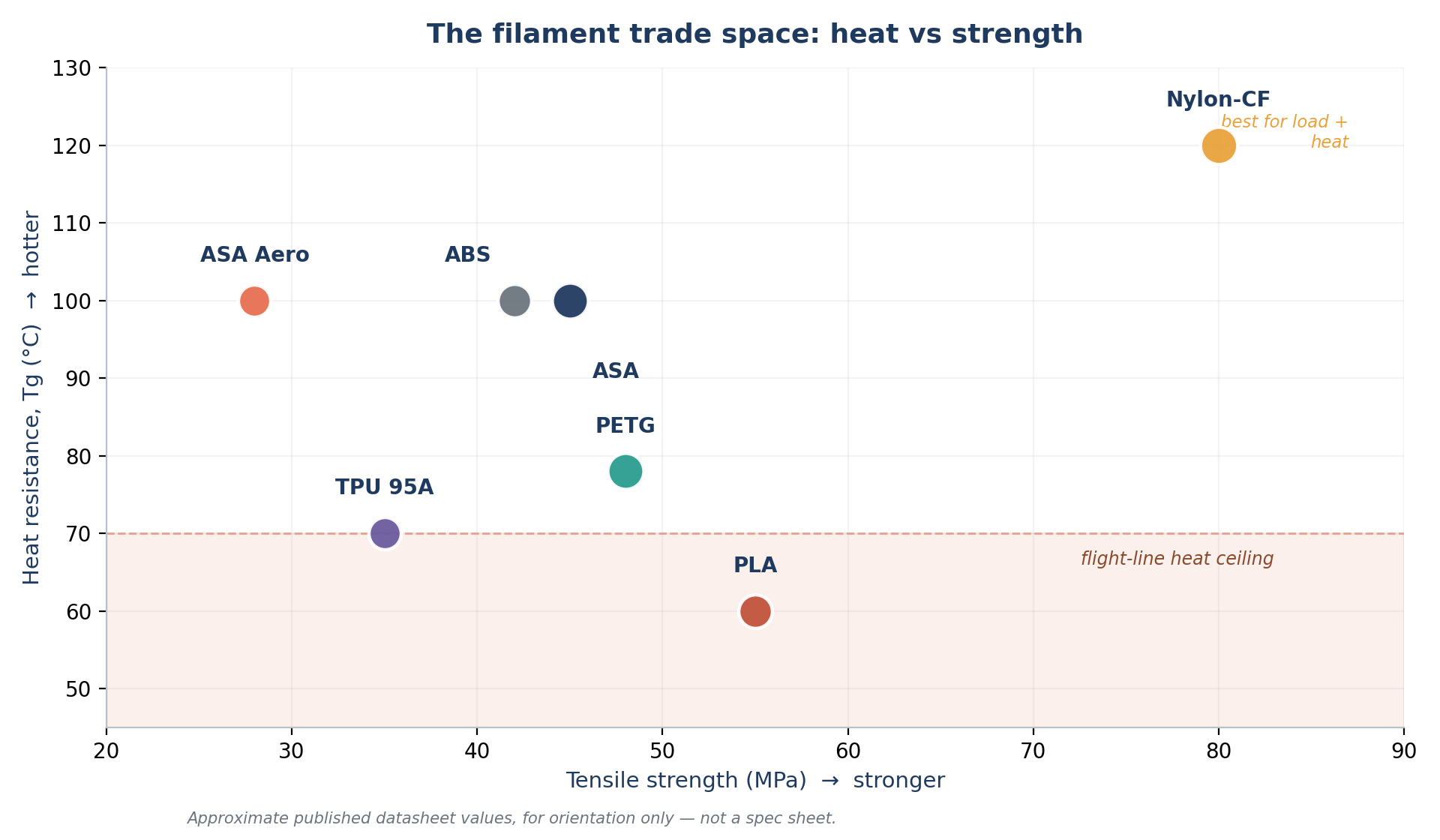
Material Comparison Chart
Where each filament sits on heat resistance versus strength; the shaded band marks where flight-line heat starts to soften a part.
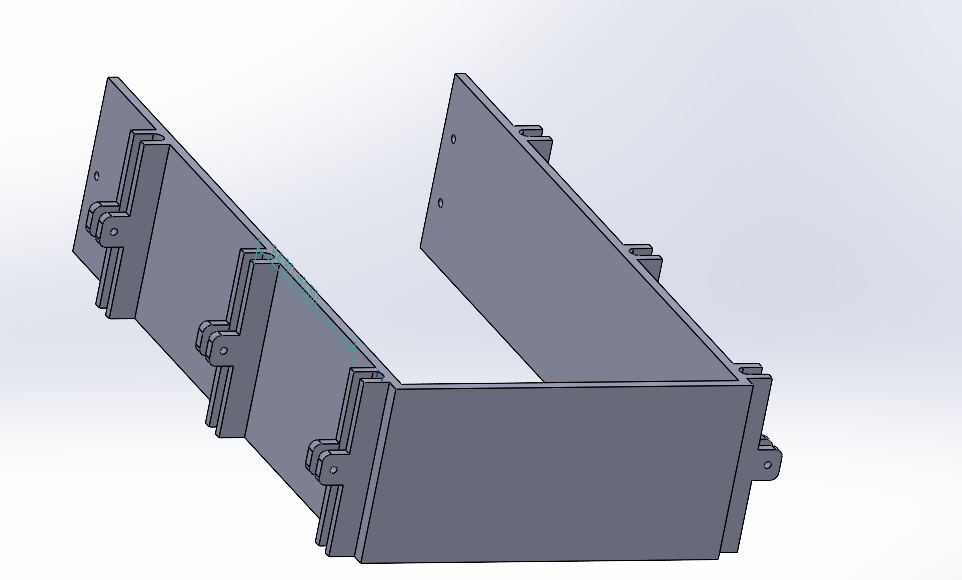
Example Printed Components
A structural component modelled for printing, laid out so the flight loads run along the print layers.
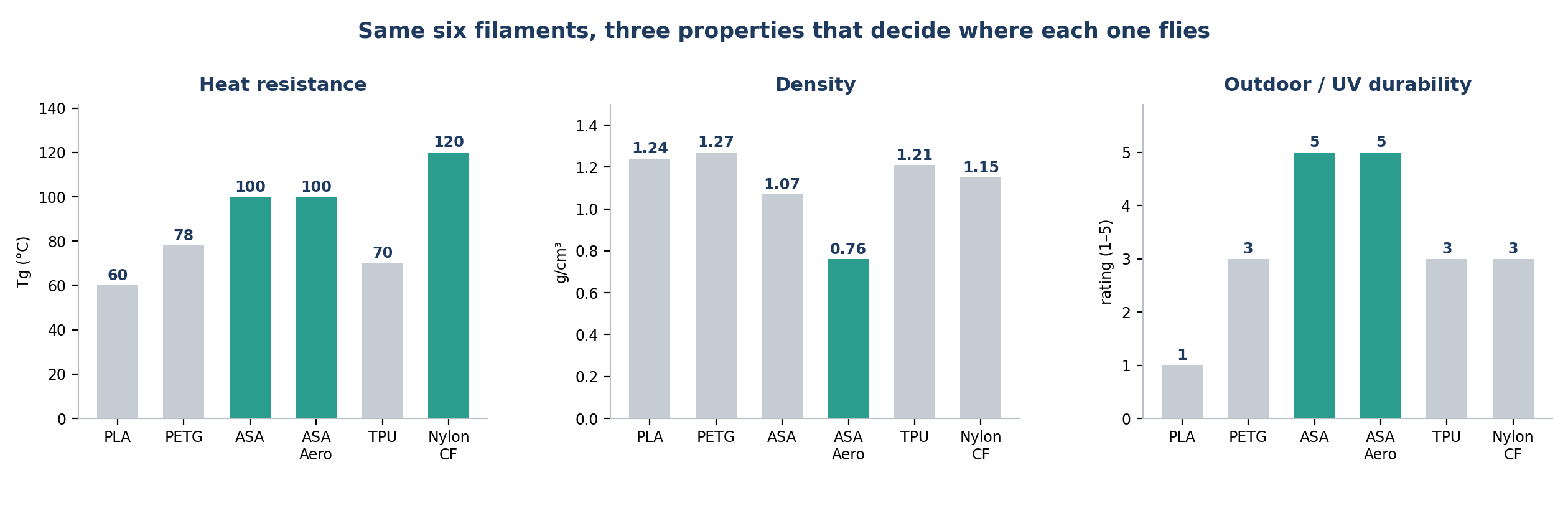
Material Selection Figure
The same six filaments scored on heat resistance, density, and outdoor durability — the three properties that decide where each one is used.