
Fifty Meters, Controlled: Validating the Drop and Retuning to 35–15
A passive braking stage is only as good as its worst drop, so before the mechanism goes anywhere near competition it has to prove it delivers safely and repeatably. And because the braking comes from the whole assembly — damper, pulley, friction, drag, and the way the second stage engages — the only test we trust is a full-assembly drop, not a bench measurement of the damper on its own.
We ran the campaign with a 25 m free-fall stage followed by a 25 m braked stage, a 50 m total drop. Across the runs the sequence held together every time: the servo released the payload cleanly, the payload cleared the mechanism, the free-fall line paid out, the second section engaged the rotary-damper pulley, the descent transitioned into a noticeably slower braked phase, and the payload reached the ground operator at a controlled speed. The full 50 m deployment took about 36 seconds.
Nothing was damaged and no one was hurt: across the tests the payload was received without injury, and the frame, pulley, casing, and line were inspected after every run and came back undamaged. The record below is split by payload, since the water bottle and the lighter beacon were tested as separate builds on the shared mechanism.
| Measured parameter | Water bottle | Beacon |
|---|---|---|
| Successful tests | 5 | 6 |
| Release success rate | 100% | 100% |
| Total drop time | 36 s | 32 s |
| Final structural condition | Undamaged | Undamaged |
With the 25–25 arrangement proven, the next step is a tuning change rather than a redesign. We are moving to a 35 m free-fall stage and a 15 m braked stage to shorten the total deployment time while keeping enough braked distance for the damper to bring the payload down to a safe hand-off speed. Because the frame and the payload masses are unchanged and both builds sit inside the range we have already tested, this is a controlled adjustment — and it earns its place through a final round of ground drops before competition, not before.
| Configuration | Free-fall | Braked | Status |
|---|---|---|---|
| Tested arrangement | 25 m | 25 m | Successfully tested |
| Selected arrangement | 35 m | 15 m | Final validation planned |
Figures & Diagrams
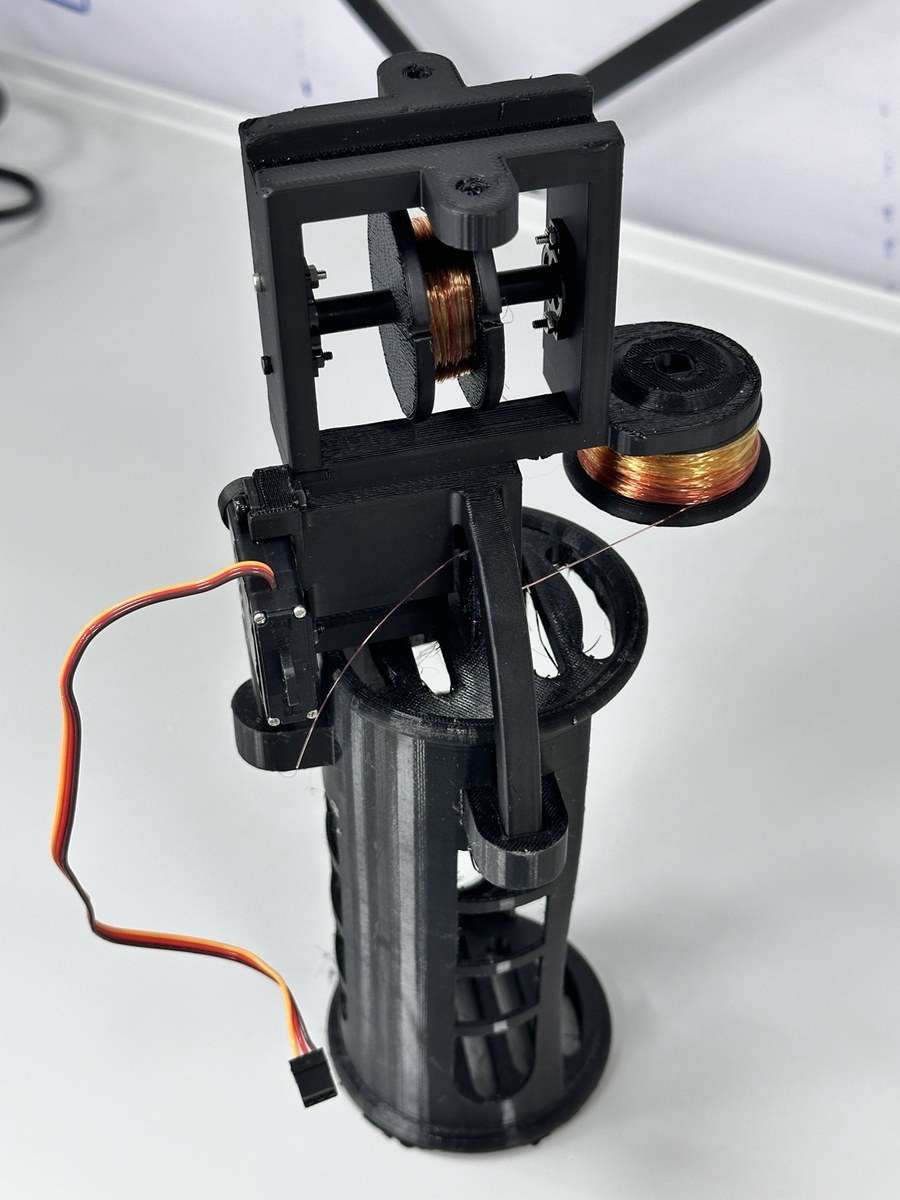
The Tested Mechanism
The fully assembled water-bottle drop mechanism used in the drop tests — dual spools, servo release, and the payload cage. The same mechanism carried the beacon build.