
Building ASCENT-1's Battery Architecture
This week we locked in one of the biggest decisions for ASCENT-1: how it stores and carries its energy. After weighing the options we committed to a lithium-ion main pack, mostly for the energy density — for a mission that has to stay airborne long enough to search an area, identify targets, and deliver a payload, every extra watt-hour we can carry without adding dead weight counts.
Choosing a configuration wasn't a guess. We modelled how much energy each candidate pack would burn across the real phases of a mission — the climb out, the cruise to the search area, the hover and maneuvering while searching, and the descent — and compared several battery counts side by side. Breaking the draw down phase by phase made the trade-off clear: more batteries buy endurance but cost weight, and past a certain point the extra capacity isn't worth what it adds to the airframe.
The other thing shaping the design is the competition's easy-to-transport battery rule, which caps how much energy any single pack is allowed to hold for shipping and handling. Rather than one large battery, that pushed us toward several smaller lithium-ion packs wired together — enough total capacity for the endurance we need, with each unit staying under the limit. The configuration we settled on is the balance point between all three pulls: endurance, weight, and staying easy to transport.
Figures & Diagrams
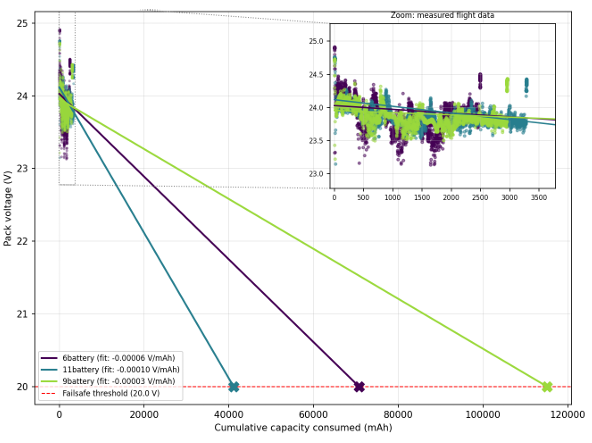
Discharge Prediction
Battery discharge behaviour used to estimate usable endurance for the selected configuration.
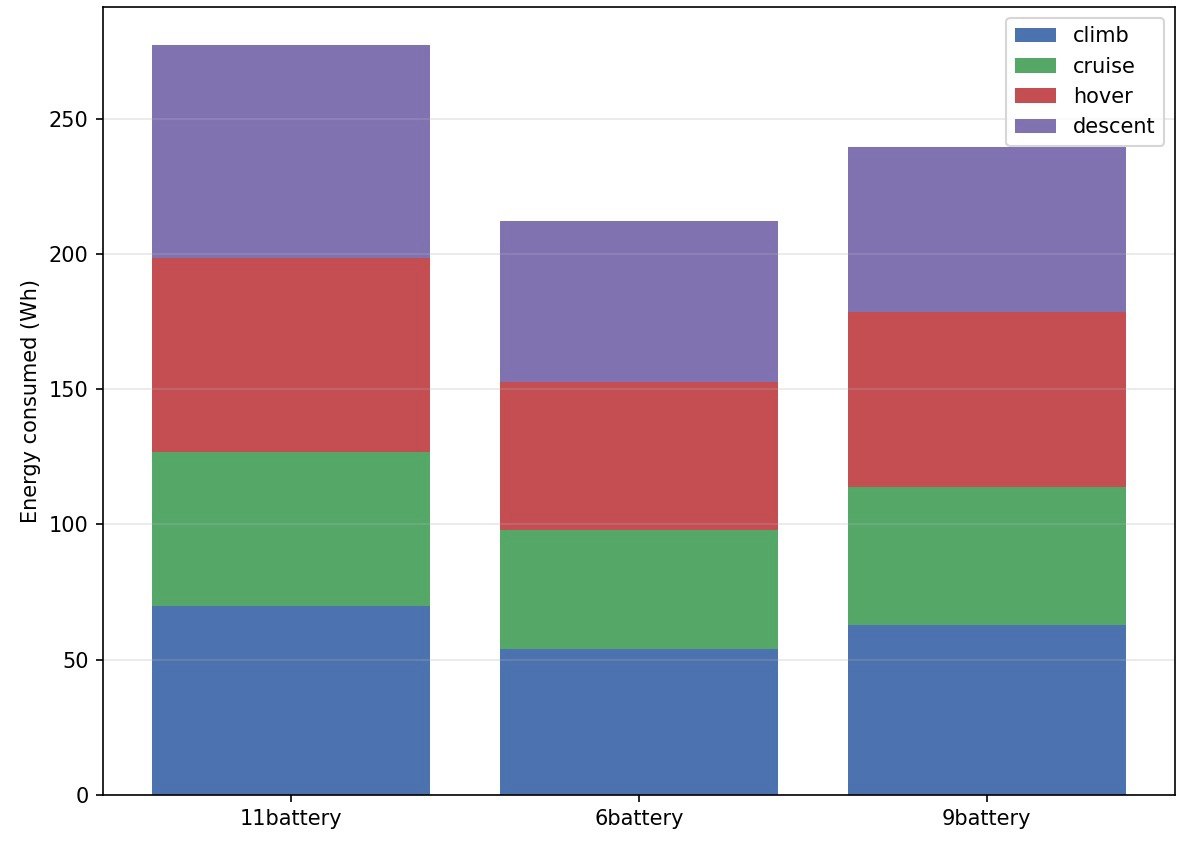
Energy Consumption by Phase
Modelled energy use for each candidate battery configuration, broken down across the climb, cruise, hover, and descent phases of the mission.